Dear HansJuergen,
Israel is at war, but the struggle over its future is being decided not only on the battlefield, but also on the home front.
Under cover of war, the Netanyahu government has resumed with renewed force what it started before October 7: weakening the institutions that can still restrain executive power. The courts are under pressure. The attorney general is under attack. Independent media is in the crosshairs. The police have been bent to political purpose. And with another election approaching, there is growing reason to worry not only about who will win, but about the conditions under which it will be held at all.
This crackdown on democracy is being done amid sirens, emergency regulations, and public exhaustion. That is how democracies are hollowed out: not always by a single dramatic act, but by wearing down the gatekeepers, normalizing abuses of power, and teaching the public to look away.
At the same time, the war is exposing once again the hierarchy of Israeli society. Those with means are better protected. Those without them are more vulnerable – to missiles, to displacement, to lost income, and to neglect. Palestinians, especially, are pushed further out of sight as the conflict widens, while continuing to face daily violence, dispossession, and the expanding reach of settlements in the West Bank. And beyond Israel, Jewish communities are facing a new escalation of threats, vandalism, and violence, as a regional war spills into streets and institutions far from the Middle East.
In such a reality, independent journalism is not a decorative part of democracy. It is one of its last defenses.
At Haaretz, we try to do what a free press is supposed to do: report what the government prefers to obscure, follow the money and the ideology behind policy, examine the uses of war at home as well as abroad, and provide the full picture to readers – not only military developments, but the condition of democracy, the fate of civilians, the reality in the West Bank and Gaza, the pressure on free expression, and the steady corrosion of public norms.
When others demand conformity, journalism must insist on scrutiny. When fear narrows the public mind, journalism must widen it.
That work now needs defenders, not only readers. It is not surprising that those in power seek to weaken it.
One way to defend independent journalism is to pass it on. Students today are forming their political judgment in an environment saturated with propaganda, tribalism, manipulation, and algorithmic noise. They need access to reporting that is factual without being obedient, critical without being dogmatic, and liberal without being naive.
As a Haaretz subscriber, you are already part of that effort. Now, you can extend it.
By sponsoring student subscriptions worldwide, you help ensure that the next generation has access to journalism that challenges power, resists simplification, and insists on the full picture. Your support does more than sustain independent reporting today – it passes it on.
If you believe this work matters, I invite you to take the next step:
help place independent journalism in the hands of those who will shape what comes next.
Sincerely,
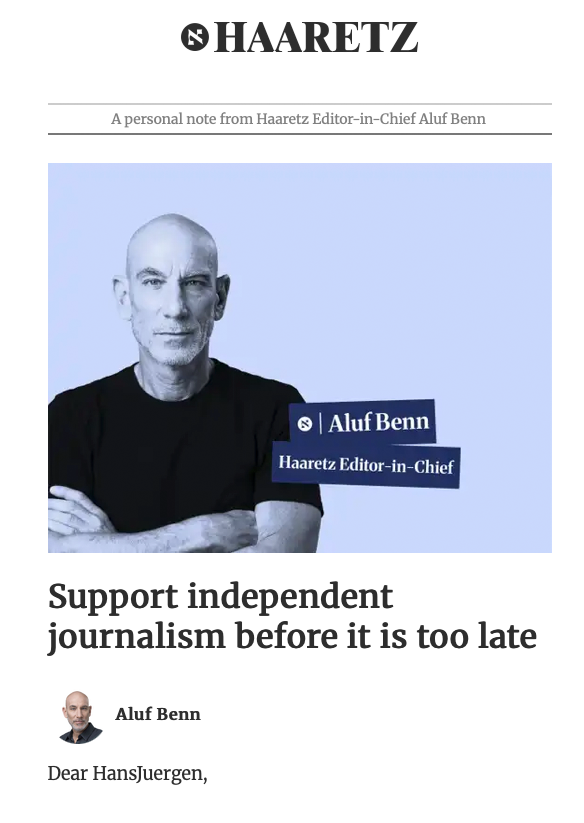
Aluf Benn
Editor-in-Chief, Haaretz